F1 Tyre Degradation Analysis
Python, pandas, NumPy, SciPy, Matplotlib, FastF1 · 2026 · Independent project using public data, not affiliated with any F1 team
The question
How fast do F1 tyres actually wear? I looked at Liam Lawson and Arvid Lindblad of Racing Bulls at the 2026 Singapore and Bahrain Grands Prix.
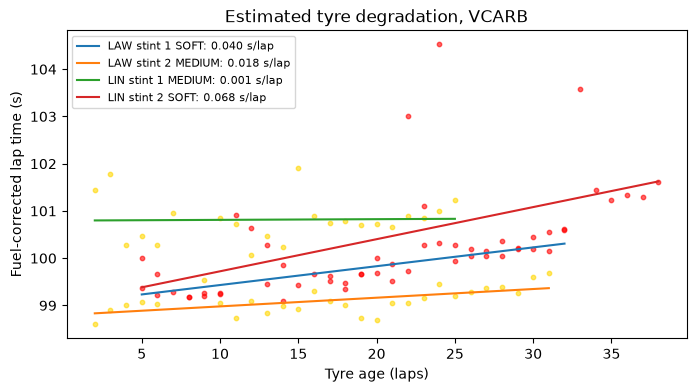
Fuel-corrected lap time against tyre age, per stint
Why it is harder than it looks
Raw lap times hide tyre wear. As fuel burns off, the car gets lighter and faster, which cancels out some of the time lost to worn tyres. Pit laps, safety cars, and traffic also make laps slow for reasons that have nothing to do with tyres.
What I did
- Loaded the race data with FastF1: every lap, plus tyre compound, tyre age, and track status
- Cleaned the laps. Removed pit laps, safety car and yellow-flag laps, lap 1, and laps far slower than the fastest, which usually means traffic or a mistake
- Corrected for fuel. Added back an assumed 0.03 seconds per lap, so a lighter car did not mask the wear
- Fitted a wear rate for each stint. A straight line of lap time against tyre age. The slope is the seconds lost per lap of tyre age, with a rough 95% range so it is clear how much to trust it
- Tested my own assumption. Reran everything with fuel values of 0.02 and 0.04 to see if the conclusion changed
- Compared telemetry. Overlaid both drivers' speed traces on their fastest laps
What I found
- At Singapore, the soft tyre wore 2 to 4 times faster than the medium for both drivers. That is about 0.04 to 0.07 seconds per lap on the soft, against 0.02 or less on the medium.
- Changing the fuel assumption never changed which stint wore fastest. It shifted every number by the same amount. So the ranking is solid, but the exact values depend on the fuel guess.
- Bahrain showed where the method stops working. Almost half the laps were removed in cleaning, and the stints were short and noisy. Most ranges included zero, so I could not say much with confidence.
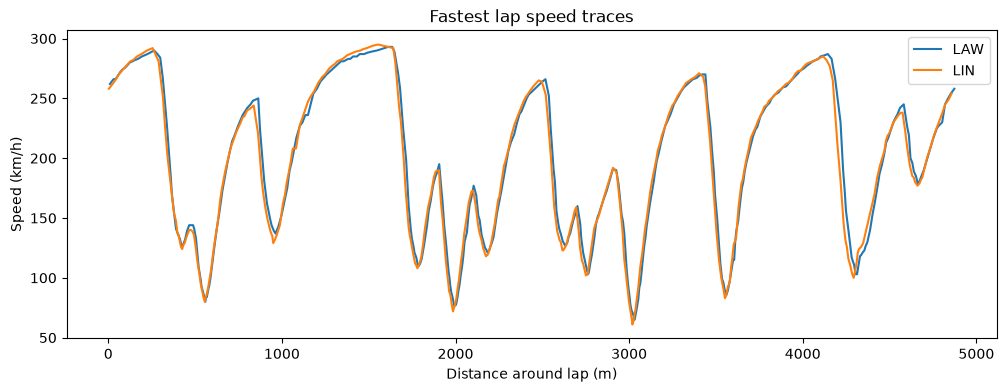
Fastest lap speed traces, both drivers overlaid
Limitations
- The fuel effect is assumed, not measured
- Track evolution is not removed. That is the track getting faster as rubber goes down.
- A straight line cannot show a tyre cliff, when wear suddenly speeds up
- Tyre pickup and debris are not visible in public data, so they show up as scatter
- Only two races are covered
What I learned
Most of the work was deciding which laps to trust. A clean number from bad laps is still wrong. Testing my own assumption showed me which results I could stand behind and which I could not.